
Interactive console
axlr-tui is AXLR's terminal interface. It streams output from OpenRouter or from local OpenAI-compatible servers, lets you review tool calls, and keeps resumable local sessions. Getting started covers the initial build and launch.
Work in a session🔗
The header shows the model, the workspace with its Git branch, and since 13 October 2026 the session's KMP about, how many memories the store holds under it ("new project" when none) and whether the session's MADE instance is open, then the connected engines; a narrow row drops the memory segment first. Before a session's first prompt, at launch and after /new, it shows the engines the launch connected and MADE instance at the first prompt; the first turn's catalog then names the session's plugins (until 14 October 2026 neither showed until the first prompt). /mcp shows under each engine its store, how it was chosen, the about and the console's work identity (decisions J1 and J2 of the lifecycle integration design). The console uses the current directory unless --root names another existing workspace. Type a prompt and press Enter. Shift+Enter, Ctrl+J or Alt+Enter insert a newline: terminals without the kitty keyboard protocol or xterm's modifyOtherKeys (tmux with extended-keys off, VTE terminals) send Shift+Enter as Enter, while Ctrl+J and Alt+Enter reach the console everywhere. Ctrl+G opens the draft in $VISUAL, else $EDITOR, else vi (notepad on Windows), and puts what you save back in the composer; quitting the editor with an error leaves the draft as it was. While AXLR is running, sending another message queues it: the transcript shows it as queued and the footer adds “message queued”. The current model step is not interrupted, so a reasoning model keeps its work. When the step ends in tool calls, the queued message joins the running turn after their results and the next model request carries it, marked for the model as sent while it was working, so it answers both; when the step ends in an answer, the queued message starts the next turn. A workflow step is never joined: the console stops it at its next model request and starts a turn with the message, without reporting that stop as an error. Several messages sent meanwhile are joined. Esc still cancels the running step, and a message still queued comes back to the composer, ahead of anything you were typing, instead of starting the next turn; Enter sends it. While a turn runs the footer says what it is doing with a clock for that phase, which restarts at every request and tool (Waiting for model · 6s), followed by the whole turn's (⏱ 1m42s, t with ASCII icons), which counts from the prompt and keeps counting while an approval card waits. Up and Down in the composer browse only this session's user messages and return to the current draft. The first model choice is made through /model or --model. Enter in /model changes the model of this session only; Ctrl+Enter (or Ctrl+D, for terminals that send Ctrl+Enter as Enter) also saves it as the default for new sessions. The first model chosen while no default is saved becomes the default either way. (Until 12 October 2026 Enter also changed the default, so trying a model for one session changed every later one.)
The model picker filters to text models that support tools. Typing filters by every word, Tab and Shift+Tab change provider, Ctrl+S marks a favorite (kept on top, saved as favorite_models, at most 50), arrows and PgUp/PgDn move, Enter selects for this session and Ctrl+Enter also as the default. :batch variants, which answer within hours, are not listed unless the session already uses one. A catalog failure offers Retry. A --model value bypasses the catalog for that launch. The selected model can change later only when the turn is idle, complete or interrupted without pending tool calls; the transcript remains in the session.
| Control | Action |
|---|---|
Enter / Shift+Enter, Ctrl+J, Alt+Enter | Send / insert a newline |
Ctrl+G | Edit the draft in $VISUAL or $EDITOR |
@ | List the workspace's files and directories that match the word after it: names that start with it, then paths that do, then names and paths that contain it, then its letters in order. ↑↓ select, Tab or Enter replaces @word with the relative path (the prompt carries the path, not the file; the model reads it with local_read), Esc closes the menu for that word and Ctrl+R lists again. See mention files |
/ | List the commands that match what you typed, up to twelve at a time (fewer on a short screen): those whose name starts with it, then those with an alias that does, then those whose name or alias contains it (/trab finds /jobs through /trabajos). Each row shows the command's aliases dim after its name; ↑↓ scroll the list and select, Tab completes, Enter runs the selected one. A /word that names no command is refused with Unknown command /word and stays in the composer, also with text after it (/foo bar) unless the word is a path, absolute or in the workspace: /tmp explain this and /etc/hosts what is this are prompts. (Until 14 October 2026 only a lone /word was refused, and /foo bar went to the model.) |
/new (aliases /nueva, /clear) | Start an empty session in this workspace with the session's model, in normal mode; the previous one stays in Ctrl+O. Refused while a turn or operation runs or a tool call waits for a decision, with the reason in the footer. Also New session in the action palette (N) and the first row of Ctrl+O, which keep the composer's draft |
/model | Choose a model |
/normal, /review, /writer, /research | Choose direct work and its local tool policy (aliases /revisar, /escritor, /investigar) |
/stop-ceremony | Cancel the running workflow in MADE and return to normal mode (alias /parar); see a step the model will not hand back |
/plan (alias /planificar) | Open the plans panel: recent plans with their tasks, sync and changed files; n arms planning for the next prompt (the brief becomes verified atomic tasks you approve, run by workers) and r resumes an interrupted plan. Without MADE plans it arms planning directly. /plan <goal> arms planning and sends the goal as the brief in one step (until 14 October 2026 it was refused with usage: /plan). See plans |
/debug, /delivery, /incident, /repair, /improve (aliases /depurar, /entrega, /incidente, /reparar, /mejorar) | Select a console-driven MADE procedure for the next prompt; /incident, /repair and /improve also open a pending approval card; /repair opens the self-repairs and improvements panel when the agent requested one from this session, and /improve does when one of them is an improvement |
/jobs (alias /trabajos) | List every repair and improvement of every session and console with its step, pull request and owner; start one from a brief, decide, recover, read its checks and queue green pull requests to merge in order. See jobs and the merge queue |
/update | Install KMP and MADE when they are not connected, and update the local ones that are |
/mcp | Inspect connected MCP servers, tools and approvals |
/approvals | Show saved always-allow tools and autonomy mode |
/autonomy on / /autonomy off | Automatically approve permitted known tools, or restore normal policy; /autonomy alone shows the current state |
/plugin (alias /plugins) | Browse packages installed in AXLR and available sources |
/theme | Preview and save appearance |
/changes / /diff / Ctrl+D | Review this session's file changes; with a draft in the composer Ctrl+D deletes the character after the cursor instead |
/undo (alias /deshacer) | Put back every file the last turn changed, or the most recent turn that changed files when the last changed none, after a y; see review file changes |
/usage (alias /uso) | Show this session's tokens, cost by provider, latency and budget; see cost and budget |
/axlr-info | Play the AXLR emblem the README shows, full screen: the chevrons spring in from the left, each letter drops with a bounce, a light sweeps the letters and the tagline types itself (animated with harmonica springs, in half blocks scaled to the screen; letters cream on a dark theme, near black on a light one). Under it: AXLR's version, the installed KMP and MADE versions (kmp-mcp --version and made-mcp --version of the configured engines, or not installed), the session's model and whether it goes through OpenRouter or a local server, and Jev: off, or on with its pinned model and its methods, the axlr_judge tool and the final check with its threshold. r plays it again; Esc, Enter or q close it, and other keys do nothing |
Ctrl+P | Open the action palette; Continue interrupted turn and Cancel turn are listed only when there is a turn to continue or something to cancel (until 14 October 2026 they were listed on an idle console), and their keys R and C still say why they do nothing |
Ctrl+O | Open a saved session |
Ctrl+F | Search the current conversation as drawn: the footer counts every occurrence (2/5), the current one is marked apart from the others and scrolled into view; Enter or ↓ goes to the next, ↑ or Shift+Enter to the previous, and keys that leave the query as it is keep the place |
Ctrl+R | Explicitly continue an interrupted turn |
PgUp / PgDn, mouse wheel | Scroll the conversation. While it is not at its end, a row above the composer says so, ↓ 12 new lines · End, counting the lines added since it left the end; a click on it, End with an empty composer (with a draft End moves its cursor) or Ctrl+End go back to the end. Sending or queueing a prompt, and Ctrl+R, go back to the end too (until 14 October 2026 they kept the scroll, and the prompt and its cards stayed below the view) |
Ctrl+Home | Go to the start of the conversation |
F1 | Show in-app help |
Esc | Drop a selection, close an overlay or cancel the active turn; the footer then says “Cancelled” beside the session state and cost, and the conversation ends with “Cancelled by you” until the next message |
Ctrl+C | Cancel active work; when idle the first press clears a non-empty draft (↑ brings it back) or says “press Ctrl+C again to quit”, and a second press within two seconds quits |
/exit (alias /quit) | Quit |
| Drag over the conversation | Select text and copy it on release; double click takes a word, triple click a row, Shift+click extends |
/copy (alias /copiar) | Copy the last reply as the model wrote it, or the current selection; /copy code copies the last reply's last code block and /copy 2 its second, without the fences |
/clean-screen (aliases /clean_screen, /cls, /limpiar) | Clear the conversation from the screen without closing the session: the history stays in the session and in the model's context, /copy, /export and /usage still see all of it, and what follows is drawn on the empty screen; Ctrl+F searches what is drawn. Opened again after another session, or after a restart, the session is drawn whole. /new (alias /clear) is the one that starts another session |
/natural-writing (aliases /natural_writing, /escritura-natural) | Turn natural writing on or off, for recording demos. While it is on, a paste into the composer is typed in a character at a time at about 15 characters a second, with some jitter and a longer pause after a space, a punctuation mark or a line; the footer reads natural writing. Any key, Enter and Esc included, completes the paste at once and does nothing else, so the prompt is sent only by the Enter that follows. A paste of more than 20 lines still appears at once as its [pasted N lines · size] token. The choice is saved as natural_writing in settings.json, so the next launch starts with it; off, pasting works as it always has |
/export [path] (alias /exportar) | Write the session as Markdown: title, model and dates, each prompt and reply, a row per tool call with its arguments, the console lines and the cost the ledger knows. Without a path it goes to <workspace>/.axlr/exports/<title>-<yyyymmdd-hhmm>.md (a second export within the minute adds -2); a relative path is the workspace's and ~/ the home directory. An existing file is never replaced. The footer says where it went |
/session [export [id]] (alias /sesion) | Alone, the session's MADE instance and the last turn's record. /session export writes the open session (or the saved one id names) as a bundle, <workspace>/.axlr/exports/<id>-<yyyymmdd-hhmm>.axlr-session.json: the transcript, its times, mode and console notes, the title and the about, the MADE instance and where it was exported from. Another console resumes it with axlr-tui --import <file> (decision I4 of the lifecycle integration design): the session is saved there bound to that workspace, its instance continues in a successor that names the imported one as predecessor, and the handoff is recorded under ws:<id>; when the bundle came from another workspace, Ctrl+D marks the changes made there other workspace, names that workspace and refuses to restore them, as /undo does (until 14 October 2026 they were listed as this workspace's and the restore failed); a session open in another console of the same state directory is refused in plain words |
/tools · /tools search <terms> · /tools install <name>[@version] [--from <catalog>] · /tools update [name] · /tools remove <name> (alias /herramientas) | The workspace's forged and installed tools and the catalogs' pre-forged ones; install shows the install card and y writes the tool. See installing catalog tools |
/memory save · /memory compare <about>… · /memory forget <ref> [why] (alias /memoria) | The person's memory commands (decisions A4, D7 and E15). save exports the project's about as the checkout's bundle .kmp/memory.jsonl with kmp-mcp export, a live engine does not block it, and git decides whether it travels. compare reads kmp_relate between the session's about and the ones named, in the session's context, and shows the declared relations, the proposals from shared coordinates and how many entries were read per about; it writes nothing. forget closes an entry: an observation under the entry's about that supersedes it, with the reason and the command typed as evidence; the entry stays, superseded, and is never removed. There is no write command and no /memory view: nothing reaches the project about without evidence, and KMP's own viewer reads the store |
The interface supports mouse controls where the terminal supplies them. Buttons, footer hints, catalog rows and the file-change list respond to a left click; the wheel scrolls the conversation and every scrolling panel. In a scrolling panel (info, /usage, /session, the /mcp and /plugins detail, F1) Home and End, or Ctrl+Home and Ctrl+End, go to its start and its end besides PgUp/PgDn (until 14 October 2026 the info panel and the others ignored them). The console keeps mouse reporting on while it runs, so a plain drag is seen by AXLR rather than by the terminal; see copy and paste. In an approval dialog, inspect the exact target and arguments with arrows, PgUp/PgDn or the wheel. A local_edit card shows the file's path and the edit as a diff, the old text as red - lines and the new text as green + lines, unchanged lines once as context; a local_write card shows the path, the mode and the content (its first 400 lines), and over a file that exists in the workspace (up to 64 KiB of text) the diff against it as an edit's card does, after how many lines it adds and removes (against the file on disk: +1 -1 lines; until 14 October 2026 a replace listed the whole new file); a local_exec card shows the command line as a shell reads it ($ go vet ./buildinfo/...), then the working directory, the timeout, the output limit and the standard input only when the call sets them, under a warning when it runs code its arguments hide (standard input, -c) or deletes, moves or truncates files (rm, rmdir, unlink, shred, mv, truncate, also behind sudo or env): ▲ deletes or moves files; /undo cannot restore what a command changes, which informs and changes no approval rule (until 14 October 2026 such a card looked like any command); a command whose first argument repeats its program ($ echo echo hola) is flagged ▲ the first argument repeats the program (since 14 October 2026); other tools show their arguments as JSON. The card's title names the tool (local exec) without the workspace path, which the header shows, and the card grows to 60 % of the screen before its details scroll. Its keys wrap onto more rows when the screen is narrow (until 14 October 2026 they were cut, at 70 columns after l always allow…, hiding d deny and esc). A approves once and D denies after asking for an optional one-line reason in place of the card's keys: Enter denies with it, and the call's result tells the model tool call denied by user: <reason> so it can change course instead of guessing; Esc denies without one; Ctrl+C goes back to the card undecided; when more than one call waits, Shift+A (shown as A approve all N) approves the card's call and every call queued behind it, in order, as A on each card would, and a call the model adds afterwards gets its own card; Esc (or Ctrl+C) cancels the turn's pending calls instead of deciding this one, and on a card for an unknown tool Ctrl+R rejects it and continues. When offered, L executes this call and always allows the exact tool identity on future calls, F activates full autonomy and executes this call. On a local_exec card S executes the call and allows that exact command for the rest of the session: a later call with the same program, arguments, working directory and standard input (the timeout and the output limit aside) runs without a card, also in review, writer and research modes, where S is the only allow on offer. It lives in this console's memory only: nothing is saved, another or reopened session asks again, and nothing matches by prefix or by program name, since git diff --output, git -C and git -c can write anywhere. /approvals lists saved choices. The autonomy switch approves known tools that the work mode permits; it persists until turned off. Reading the workspace never needs a card: local_read, local_search and local_list run without one with autonomy on or off, since they change nothing; the work mode and a workflow step's own limits still apply to them first. (On 10 October 2026, with autonomy off, each read of a "where is X" question raised a card.) Writes, edits and commands keep their cards unless autonomy or an always-allow covers them. Restricted modes still require a decision for every local exec but the commands allowed with S, and a new workflow check command always needs approval. Their dialogs offer only decisions that apply to that call. Unknown tool names cannot be approved. An ordinary turn is limited to 32 tool calls (turn_tool_calls in settings, from 8 to 256); driven workflows reset the allowance as a step advances, and under the compact profile a step has 16, or the turn's allowance when that is smaller. When a fifth of the allowance is left, the next request carries one [AXLR · budget] note telling the model how many of how many calls remain and that the person's next message starts a new allowance, so it finishes or says what remains instead of being cut mid-work; the note does not restart the allowance. (Without that last part, claude-haiku-5.5 stopped one call into the next turn on 9 October 2026, taking the earlier note for its new allowance.) The system prompt states the allowance from the start (a fixed sentence for the console's setting, so the prompt cache keeps it). An answer with more calls than are left runs the calls that fit, in order, and the rest are answered not run: over the turn's tool-call budget of N calls: …, which says how many of the answer's calls ran; the transcript shows them as over budget, not as denied, and they do not count toward the turn's calls. (On 10 October 2026 claude-haiku-5.5 sent 93 local_read calls with 31 left, and refusing the whole answer ran none.) A Jev final check follow-up gets only what the request left. At the limit the turn pauses: send a message or press Ctrl+R to continue with a new allowance. A console-driven workflow step is continued automatically, twice at most; see a step the model will not hand back. Cancellation does not reverse an effect that already happened. A call cancelled while it ran is returned to the model as tool call cancelled by the person before it finished, with its effect unknown and the instruction not to run it again unless you ask. (Until 14 October 2026 it read tool execution failed; effect unknown: context canceled, and glm-5.3-flash ran it again on the next, unrelated prompt.)
A click on a tool row opens what the call returned under it, and another click folds it; from the keyboard, Ctrl+P then L (Last tool result) opens or folds the last call's and scrolls to its row (until 14 October 2026 only the mouse opened a result): a command's exit code, standard output and standard error as text, a read's text, a write's or edit's diff from the snapshots /changes shows, a denied call what the model was told, and any other result as an outline of its JSON with string values unescaped and a multi-line string as a block under its key. It opens the first 200 lines and says that Info (Ctrl+P → I), which shows every result of the session the same way, has the rest. The Editorial theme sums finished tool runs up in one line, which does not open.
A turn that fails leaves its error in the footer and the same row in the conversation, such as ✗ OpenRouter invalid_request (HTTP 400): anthropic/claude-nonexistent-9 is not a valid model ID · choose a model the provider serves with /model: the provider's message and, when the error says what to do, a hint (choose a model with /model, check OPENROUTER_API_KEY or a local server's api_key_env, add credits, wait out a rate limit). The row is saved with the session as a console line, never sent to the model, so reopening the session still says why a prompt has no reply. The error sits on up to three rows above the footer's hints and state, which stay: after a failure that left the turn interrupted the hints offer ctrl+r retry, and a stream the provider cut reads in the console's language (OpenRouter cut the reply: it ran past the stream's maximum duration). (Until 14 October 2026 such an error took the whole footer, hints and state included, as raw ! OpenRouter stream maximum duration exceeded.) A cancelled turn, the tool-call limit and the budget pause are not failures and leave no row; a message queued during the failed turn starts once the row is saved. (On 12 October 2026 an invalid model id left only ! OpenRouter invalid_request (HTTP 400) in the footer, and nothing once it moved on.) An error stays in the footer until the next operation, or until a notice or a question displaces it: the panel's y restores?, /undo's question, press Ctrl+C again to quit. An error that must stay, a reply not yet saved, keeps its row and the notice shows under it. Notices (Exported to …, a copy) last until the next key press or ten seconds; /undo's question and the budget warning wait for a key. (Until 14 October 2026 an error hid every later notice, so the second Ctrl+C's warning never showed, and a notice stayed for minutes across turns.)
Mention files🔗
Type @ and part of a name to pick a file of the workspace instead of spelling its path. The console walks the workspace in the background the first time @ opens in a session, depth first and without following links, and keeps the list until a turn ends (which may have written files), the session changes or Ctrl+R in the menu. The walk stops after 20,000 entries, and the menu then says it shows the first ones. It never lists .git, .hg, .svn, node_modules, vendor, dist, target, .venv, venv, __pycache__, .cache, .idea, .axlr or .kernel (listed until 14 October 2026), nor what the simple patterns of the workspace's root .gitignore match: names and globs (*.log, build/) and paths from the root (/gen/*.tmp); negations (!), ** and nested .gitignore files are not read. The menu shows up to twelve matches above the composer, like the slash menu; Enter with no match, or right after a bare @, sends the prompt as typed, while Tab inserts the selected path.
Copy and paste🔗
Drag over the conversation to select text: the selection is painted while the button is held and copied when it is released, with a short confirmation in the footer. Double click selects a word, triple click a row, and Shift+click extends the selection to another cell. Esc drops it. The copied text follows the wrapped lines as shown, without the gutter. /copy (or Copy last reply in the action palette, Y) copies the last reply exactly as the model wrote it, including Markdown and code fences, or the selection if one exists. /copy code copies the last reply's last fenced code block, and /copy N its N-th, without the fences; the footer says which block of how many. A code line too long for the screen wraps under its own indentation inside the block rather than at the conversation's edge, so a drag over it still reads as code.
The console writes the clipboard with the OSC 52 terminal sequence, so copying works over SSH, and mirrors it to the X11 primary selection and to the host clipboard tools (wl-copy, xclip, xsel, pbcopy) when they are present. Terminals that refuse OSC 52 by default need it enabled: kitty, foot, WezTerm, Alacritty, iTerm2 and Windows Terminal accept writes, xterm needs allowWindowOps, and older VTE terminals (GNOME Terminal, Tilix) ignore them and rely on the host fallback; inside tmux add set -g set-clipboard on. The console cannot tell whether the terminal accepted a write.
Hold Shift while dragging to bypass the console and let the terminal select natively (Alt in VS Code on Linux and Windows, Option in some macOS terminals). That selection includes the gutter and wraps lines where the screen wraps them. Paste with the terminal's shortcut (Ctrl+Shift+V, Shift+Insert, Cmd+V) or Shift+middle click; bracketed paste keeps newlines in the composer without sending the message. A paste of more than 20 lines shows in the composer as one token, [pasted 200 lines · 6.1 KB], which you can type around or delete; the prompt sent, and saved, carries the whole text in its place (a token you edit stays as typed). The conversation shows that prompt with the token too, and a click on it opens the full text and folds it again. A prompt of more than 20 lines the console did not see pasted, such as one in a session saved earlier, is shown folded as [N lines · size] the same way. Ctrl+G opens the draft with the pastes in full.
Work modes🔗
Select a mode with its slash command between turns, after choosing a model. The mode is saved with the session and applies to subsequent work; switching while busy or with pending calls is refused. normal is the default for a new session.
| Command | Purpose | Local tool policy |
|---|---|---|
/normal | General agentic work | All six local tools, under saved approval policy |
/review | Findings with locations, failure scenarios and evidence | Read, search and list; write/edit hidden and refused; every exec needs approval, or S for that exact command |
/writer | Brief, outline, draft, critique and at most two revisions | Write/edit only .md, .mdx, .txt, .rst or paths under docs/; every exec needs approval |
/research | Recover memory, read primary sources and produce a supported decision | Same document write policy as writer; every exec needs approval |
/plan | Decompose a brief into atomic tasks you approve; workers run them | No edits while planning; workers (task sessions) run autonomous local tools within each task's scope; console drives axlr_plan, axlr_task and axlr_sync 1.0 |
/debug | Reproduce, diagnose, repair and integrate | All local tools; console drives MADE axlr_debug 2.0 |
/delivery | Brief, build/check and integrate | All local tools; console drives MADE axlr_delivery 2.0 |
/incident | Blameless postmortem with review and person's approval | All local tools; model KMP outcome writes refused; console drives MADE axlr_incident 1.0 |
/repair | Repair the configured repository in a fresh clone; the console opens, watches and merges the pull request | All local tools; model KMP writes refused; console drives MADE axlr_repair 1.0; start it with axlr-tui --repair "<brief or #issue>", or let the agent request it with axlr_request_repair from any session |
/improve | Improve the configured repository in a fresh clone against a check that fails first; the console opens and watches the pull request, and the person decides the merge | All local tools; model KMP writes refused; console drives MADE axlr_improve 1.0; start it with axlr-tui --improve "<brief or #issue>", or let the agent request it with axlr_request_improvement from any session |
review, writer and research refuse any local exec with nonempty stdin, including when full autonomy is enabled. Arguments remain visible for per-call review. These restrictions apply to AXLR's local tools: MCP calls retain their own approval policy and may have external side effects. An approved process is not sandboxed by the mode; the optional exec sandbox confines every local command whatever the mode.
Direct modes do not start workflows. For debug/delivery/incident, prepare MADE, select the mode, then send the task. AXLR starts and claims the pinned definition; the model performs the work and hands results to axlr_step_done. A new debug/delivery check command is approved once, then reused unchanged for repair/build verification. Incident drafts receive a fresh-context review, then the person's approval through the /incident card. On COMPLETED or BLOCKED, the session returns to normal mode. Missing MADE or definitions prevents this start; there is no silent substitute workflow. Workflows describes the two execution paths and recovery limits.
The local process environment contains only a sanitized absolute PATH and the host's HOME when it is absolute, so tools find their usual configuration (~/.gitconfig, ~/.cargo, caches). Other shell variables and provider credentials are not inherited by console exec/check commands. A check that works in your login shell may therefore need explicit paths or a workspace script with documented prerequisites.
Exec sandbox🔗
Without a sandbox a local command runs with your rights: in full autonomy, or in a repair session with repair.autonomous, the model's commands can write anywhere in your home directory, read your keys and reach the network. exec_sandbox in settings confines every local_exec, and every workflow check, forge and git command the console runs through the same runtime, under bubblewrap on Linux:
"exec_sandbox": {
  "mode": "auto",
  "network": true,
  "writable": ["/home/you/.cache/go-build", "/home/you/go/pkg/mod"]
}
A confined command sees the whole filesystem read-only, a fresh /dev and /proc, a private /tmp that is discarded when it exits, and only the workspace and the writable paths (absolute, existing, at most 32) writable. network: false gives it a network namespace of its own with nothing in it, which also stops the console's git push and gh in /repair and /improve. Its exit status, output capture, timeout and cancellation are those of an unconfined command.
mode is off (the default), auto or required. At launch the console looks for bwrap and runs one trivial command under it; with auto a platform that cannot confine (bubblewrap missing, unprivileged user namespaces refused, macOS or Windows) runs commands unconfined, the launch says why in one line on stderr and the header shows ! sandbox off, with the reason and the fix in F1 help and Ctrl+P → I; with required every local command is refused with that reason instead. Any mode but off prints what it got. The default is off because a read-only home breaks common checks until their caches are listed: go test writes ~/.cache/go-build and ~/go/pkg/mod, cargo ~/.cargo, npm ~/.npm. A Landlock backend, which needs no user namespace, is not implemented.
Review file changes🔗
Open /changes (or /diff, Ctrl+D, or File changes in the action palette) to review completed local write and edit calls, newest first. A Changes hint with the number of changed files appears after the first change. The list has one row per file with its net change, from the first step's before to the last step's after; a file written several times expands into its steps (→ or Enter), so each edit remains individually reviewable. The preview shows the exact before and after text, line numbers, three lines of context, and added/removed counts. It works without Git and survives reopening the session, even if the workspace file has since changed.
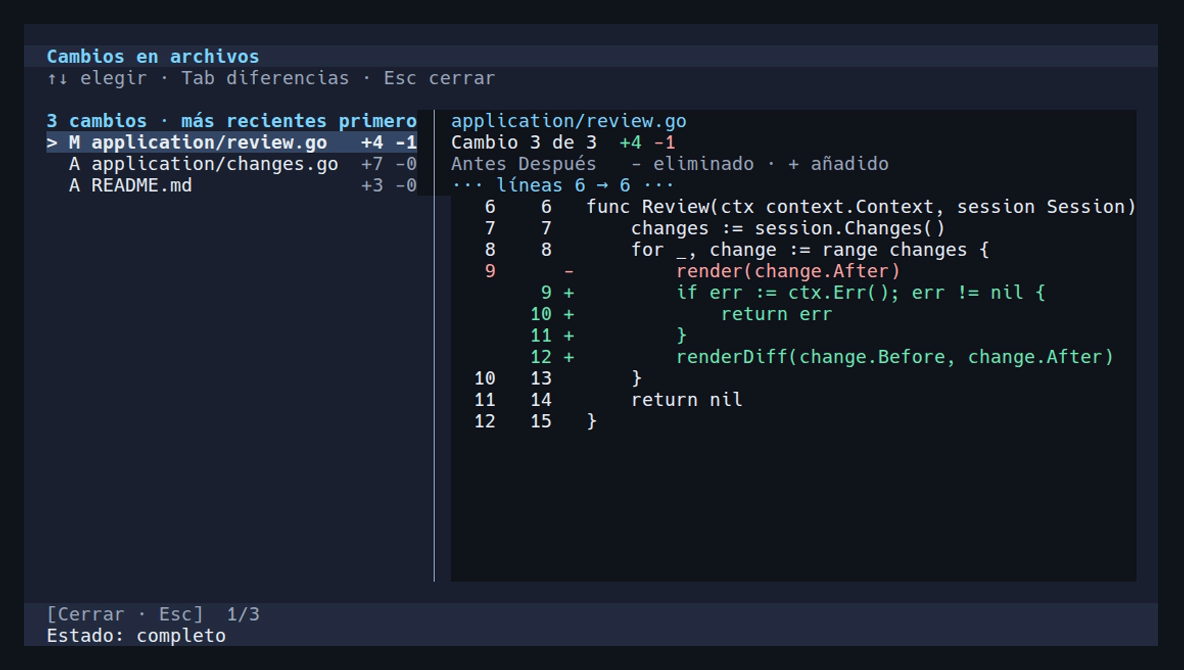
u puts the selected step's file back to what it held before that step (on a file with one step, the file's row will do; a file with several asks for one of its steps with →); the footer of the panel asks first, and y restores while any other key keeps the file. /undo puts back every file the last turn changed, newest step first, after the same y in the footer. When the last turn changed no file, it offers the most recent turn that did and was not undone (The last turn changed no file: undo turn 3's changes to calc/calc.go, calc_test.go? y restores), with the same y and the same refusal of a file changed since. A step you already restored from the panel counts as undone: /undo leaves its file out and puts back what remains, and a turn whose every step you restored is not offered (until 14 October 2026 /undo offered such a turn, found the restored file changed and undid nothing at all); the transcript then says undid turn 3: restored … (until 14 October 2026 it only said the last turn changed no file). A restore writes through the session's own local tools, so the workspace root and the exec sandbox's rules hold, and it refuses, saying why and changing nothing, when a file no longer holds what the session wrote (an edit by hand, another program) or is not in the workspace (deleted since, or a session imported from another folder), when the step created the file (AXLR does not delete files), or when a snapshot was not kept. It does not change the model's history: the conversation shows it as a console line (⟲ restored a.go to before the selected step, ⟲ undid the last turn: restored b.go, a.go) and Ctrl+D as a step of its own, restored or undone with /undo, with its diff. Your next prompt carries one [AXLR · restore] note that names the files, whether you restored a step or used /undo (and which turn /undo reached when it was not the last one), and that the files on disk now hold the restored content; a restore made while the turn is interrupted joins the resumed turn as that note when you press Ctrl+R instead (until 14 October 2026 only a new prompt carried it) (shown as ⟲ console · told the model which files you restored). (Until 14 October 2026 the model was not told: glm-5.3-flash found calc/calc.go "reverted by someone", distrusted its own work and spent a 382k-token debug workflow investigating.) A second /undo with nothing new since says the turn is already undone. Use Up/Down to select a file or step, → and ← to expand and collapse a file's steps, and Tab or Enter to focus the diff. PgUp/PgDn and the wheel scroll; in the diff Left/Right pan long lines; Home/End jump to the beginning/end; [ and ] move to the previous or next file while reading. Esc returns to the conversation and preserves the draft. At 90 columns or more the list and diff appear together; narrower terminals switch between them with Tab. File rows and Close also support the mouse.
Previews retain at most 64 KiB and fewer than 2,000 newlines per version. Larger files and unavailable text previews show an explicit notice, without a partial or guessed diff. Failed, denied, cancelled and unchanged edits do not appear. Empty file creation does. File snapshots are stored privately with tool activity, outside the messages sent to the model. Existing sessions without snapshots remain readable; old edits cannot be reconstructed. exec commands and MCP/plugin effects do not produce file snapshots.
Appearance and language🔗
/theme offers Auto, Ink, Aurora, Paper, Phosphor and Editorial. Editorial is light and also changes the layout: speaker labels, consecutive tool calls summarised in one line, and the approval as a bottom sheet. Press I for Safe, Nerd Mono or ASCII icons; A toggles reduced motion; Enter saves. Nerd Mono needs a Nerd Font configured in the terminal. NO_COLOR=1 disables color.
The input's text, background, placeholder, selection and cursor follow the active theme, including live previews and cancellation. Auto also updates the input after detecting the terminal's background.
English is the default. --lang es or AXLR_LANG=es changes interface labels only. Prompts, tool results and stored conversation text are not translated.
Edit settings as JSON🔗
The console reads $XDG_CONFIG_HOME/axlr/settings.json, or $HOME/.config/axlr/settings.json when XDG_CONFIG_HOME is unset. The first-run setup assistant creates it; the configuration reference lists every key with its default and limits. Create or edit it with any text editor:
{
  "model": "provider/model",
  "language": "es",
  "theme": "auto",
  "icons": "safe",
  "reduce_motion": false,
  "approvals": {
    "autonomous": false,
    "allowed": []
  },
  "repair": {
    "repository": "underpass-ai/AXLR",
    "directory": "/absolute/repairs",
    "auto_merge": false,
    "watch_minutes": 45,
    "about": "project:AXLR",
    "autonomous": true,
    "max_attempts": 2
  },
  "jobs": {
    "max_active": 2
  },
  "forged_tools": true,
  "notify": "bell",
  "context_tokens": 65536,
  "max_session_usd": 5,
  "models": {
    "z-ai/glm-5.3-flash": {
      "provider": {"sort": "throughput"}
    }
  },
  "local_models": [
    {
      "id": "local/qwen3.8-27b",
      "name": "Qwen3.8-27B (llama.cpp)",
      "url": "http://127.0.0.1:8080/v1",
      "context_tokens": 65536
    },
    {
      "id": "local/gemma-4-31b",
      "name": "Gemma 4 31B (vLLM)",
      "url": "http://127.0.0.1:8082/v1",
      "model": "gemma-4-31b",
      "context_tokens": 65536
    }
  ]
}
All keys are optional. repair configures /repair, the agent's self-repair and /improve: repository is the owner/name the console may repair (default underpass-ai/AXLR), directory where it clones (default <data>/axlr/repairs), auto_merge whether green pull requests merge without the person (default false), watch_minutes how long one check round may take (default 45), about the KMP project scope (default project:<name>), autonomous whether an agent-requested repair session runs local tools in its clone without a card (default true; reads never need one; the reproduction command and the merge always wait for the person) max_attempts how many repair sessions one failure may start (default 2, at most 5) and install whether a merged repair's rebuilt axlr-tui replaces the running console's executable without the panel's i (default false; see updating the runtime). /improve uses repository, directory, watch_minutes and about; auto_merge never applies to an improvement, whose merge always waits for the person. See workflows and self-repair from a running session. model may be empty to choose a model in the console. language accepts en or es; theme accepts auto, ink, aurora, paper, phosphor or editorial; icons accepts safe, nerd-mono or ascii. In approvals, autonomous enables automatic approval for every known tool; allowed contains exact tool identities saved by the approval dialog. Edits take effect on the next launch. --model overrides the JSON model for one launch; --lang overrides AXLR_LANG, which overrides the JSON language. Saving a default in /model (Ctrl+Enter), saving /theme, or changing /autonomy or always-allow choices updates the corresponding JSON keys while retaining other settings, including keys from newer AXLR versions. The console writes the file with owner-only permissions and rejects invalid JSON without replacing it.
prompt_tokens (the prompt a request to a model without a known window may reach; default 64,000, at least 16,384) is described under model context, max_session_usd (default 0, no limit) under cost and budget, context_tokens and local_models under local models, models under per-model request options, jev under Jev, and ceremonies.profile (auto, standard or compact) under the compact profile, trace_retention_days (default 30; 0 keeps every trace) and trace_payloads (default false) under diagnostics and privacy. exec_sandbox is described under exec sandbox. engines.shared is described under shared engines. turn_tool_calls is a turn's tool-call allowance (default 32, from 8 to 256; see work in a session). plan.model names the model that decomposes a brief (default session, the session's model) and plan.auto_approve starts a verified plan without the person (default false); see plans. jobs.max_active bounds the repair and improvement sessions active at once across the consoles that share <state>/axlr/repairs.json, whether the agent or the person started them (default 2, from 1 to 8); see jobs and the merge queue. forged_tools (default true) offers the model forged tools. reviewer_model names the model of the fresh-context review of an /incident postmortem (empty: the session's model). favorite_models holds the models marked with Ctrl+S in /model; it is read again each time /model opens. notify is how the console calls you back when it needs you: bell (the default) rings the terminal's bell, osc also sends an OSC 9 desktop notification (iTerm2, kitty, WezTerm, Windows Terminal, ConEmu; inside tmux it needs allow-passthrough), and off stays silent. It rings when a turn that took ten seconds or more ends (not when you cancelled it) and whenever an approval card or a plan, postmortem or repair card appears. Whatever the setting, unless TERM is dumb, the console keeps the terminal's title at AXLR · <state> · <session>, the state being ready, working, waiting for you or error and the session its title or first prompt, and on quitting it puts back the title it found (through xterm's title stack; a terminal without one is left with an empty title).
Existing model-preference.json and ui-preference.json files under the state directory are read until settings.json exists. Existing approvals.json choices are read until settings.json has an approvals section. The next related change writes those values into settings.json; the old files are left in place. MCP server connections and their own approval policies remain in the separate $XDG_CONFIG_HOME/axlr/mcp.json file.
Model context🔗
The private session store retains the full transcript. Since 13 October 2026 a request's whole context (guidance, tool schemas and messages) is bounded in tokens (decision D10 of the lifecycle integration design): the console counts it with one tokenizer for every model (tiktoken's o200k, each message counted once), scaled by what the provider reported for the model's earlier requests (on 13 October claude-haiku-5.5 billed 27K prompt tokens where o200k counted 9.4K of Spanish text; the factor starts at 1 and follows the reports, between 1 and 4), and keeps it under prompt_tokens (default 75,000) for a remote model, or three quarters of the window for a local one. Under the cap nothing is dropped and no checkpoint is written, so the provider's prompt cache keeps its prefix. A request that would exceed the cap stops the turn: the session's MADE instance closes (continued at N tokens), a successor session opens with the same workspace, model, mode and about, titled after the predecessor with "(2)", and the person's prompt is sent there with a recall note that wakes the project's about, the person's and ws:<predecessor>; the footer says so and the previous session stays readable in the picker. A prompt that exceeds the cap on its own is refused with the cap's name, not continued. The per-result bounds below still apply, derived from the same prompt_tokens.
The byte budget remains the measure when the tokenizer is unavailable: four limits in bytes, not the model's advertised token window, a message-history ceiling, a low watermark the history is cut back to once it crosses the ceiling, a limit per tool result and an extractive checkpoint. Which limits apply depends on what the console knows about the model:
- A model whose window is unknown, which is every OpenRouter model, gets the prompt budget:
prompt_tokensin settings (default 75,000; the figures below are for 64,000) is the prompt a request may reach. At the 2.44 bytes per token measured on Claude Haiku 5.5, minus 17 KiB for the guidance and the tool schemas, that is a 138,752-byte ceiling, a 69,376-byte low watermark, 17,344 bytes per tool result and an 11,562-byte checkpoint. The default stays under the 100K prompt tokens above which Haiku 5.5 costs five times as much; a session of 198 requests that reached 315K tokens per request and $14.13 in total under the earlier 1 MiB ceiling replays at 62K tokens at most and $0.90 under this budget (research). The budget applies to every remote model, the plan model included; raiseprompt_tokensfor a cheaper model with a larger window, and a globalcontext_tokenssmaller than the prompt budget still bounds it. Tokenizers differ: z-ai/glm-5.3-flash held about 4.2 bytes per prompt token on 8 October 2026, so at 2.44 its requests stopped near 37K tokens. The console therefore measures each remote request, the size of the body it sent against the prompt tokens the provider counted, and keeps a moving average per model (each ratio clamped to 1.5–6 bytes; prompts under 2,048 tokens are not measured; past 50 requests a new one weighs a fiftieth) inbytes-per-token.jsonunder the state directory, shared by every console. After five measured requests the model's prompt budget uses its own ratio: 251,392 bytes of history for glm-5.3-flash at 4.2, which brings its requests to the 64,000 tokens the budget aims at. A console fixes the ratio it applies to a model the first time it uses it, the 2.44 default included when the model had fewer than five measured requests then, so the ceiling does not move under a running session; the next launch picks up what was measured since. Local models keep the window budget. - A local model gets the window budget, since its server holds the window for free: three quarters of its window at three bytes per token (147,456 bytes for 65,536 tokens), a low watermark three quarters of the ceiling, a tool result at most an eighth of the ceiling and the checkpoint at most an eighth of the low watermark. A window that holds more than the 1 MiB ceiling keeps the ceiling: 1 MiB, 768 KiB, 64 KiB per tool result and a 16 KiB checkpoint.
Without the tokenizer, when the history crosses the ceiling, whole earlier turns are dropped until it is back under the low watermark, and one checkpoint message takes their place. It quotes each omitted request of the person exactly, newest first (an excerpt when they no longer fit), and next to each the files the turn wrote, which are on disk, and the memory it recorded in KMP (about and idempotency_key of each accepted kmp_write_memory); a turn that wrote a file or ran a command in a session that uses KMP, and recorded nothing, is marked unrecorded. Console messages ([AXLR…]) belong to the request before them. The checkpoint keeps the KMP agent and context identities and the index of the last guide and protocol result, and tells the model to recover what the session settled with axlr_recall, a file from disk and one exact message with axlr_history. When the map no longer fits, older turns keep only their request and records_omitted_at_or_before says from which one. The checkpoint quotes no assistant prose.
In a closed turn, the arguments of a local_write or local_edit call of 512 bytes or more keep only their path and mode; the written text, the digest and the why are replaced by one "[omitted]" record, which no tool takes as a parameter, with the size of each text (content_bytes, old_text_bytes, new_text_bytes) and a note to local_read the file, since the file on disk holds it, and that a new call needs its full text. (Until 14 October 2026 the sizes were content_omitted_bytes and the note recover, next to the call's other arguments, and glm-5.3-flash sent that shape back as a local_write with no content, twice.) The saved transcript keeps them whole. Only completed calls are shortened; denied or failed ones stay whole. The turn in progress keeps them exact unless it alone exceeds the budget, when its own completed writes are shortened the same way, with the same note.
In a closed turn, an axlr_tools result of 512 bytes or more that returned one exact schema (called with name) is replaced by its name and one "[omitted]" record with its size (schema_bytes) and a note to ask for it again (until 14 October 2026 a flat schema_omitted_bytes and recover, the shape shortened writes left behind): the model read it to make a call that is done. Searches and listings stay, and the turn in progress keeps the schema. Host results such as exact tool-discovery schemas are retained up to 64 KiB, and axlr_history pages hold up to 32 KiB, or what the model's budget keeps per tool result when that is less, so a recovered page is never excerpted again.
A local_read page is bounded the same way: without max_bytes, or with a larger one, it holds what the budget keeps per tool result less 512 bytes for the result's offsets, status and digest (16,832 bytes under the default prompt budget), and a page whose JSON escaping (newlines, quotes, <, >, &) still overflows the budget is read again, shorter, until it fits. Its next_offset_bytes is therefore where the file continues. Under the default prompt budget, a 30 KB docs/console.md read without max_bytes used to come back as an excerpt whose next_offset_bytes was the end of the file; the model then tried a query field local_read does not have and re-read overlapping ranges. A local_read result excerpted all the same, such as one saved under a larger budget, names the offset of the first byte its excerpt omits and the largest max_bytes to read it with, and says that its next_offset_bytes follows the whole page; other excerpts suggest a narrower query, filter or page.
Per-model request options🔗
models in settings adds fields to the requests OpenRouter receives for one model. The key is the exact model id a request names, suffix included: an entry for z-ai/glm-5.3-flash does not apply to z-ai/glm-5.3-flash:nitro. The entry applies to every request for that model, the session's, a plan's, its workers' and the reviewer's. Without an entry, the default, a request carries none of these fields and OpenRouter chooses the endpoint and the defaults. An entry may hold:
| Key | Meaning |
|---|---|
provider | OpenRouter's provider routing, sent as written: order, only and ignore (lists of provider slugs), allow_fallbacks (OpenRouter's default true), require_parameters, data_collection (allow or deny), zdr, quantizations, sort (price, throughput or latency, or an object with by and partition), preferred_min_throughput (tokens per second) and preferred_max_latency (seconds) as numbers, and max_price with prompt, completion, request and image (dollars; per million tokens for prompt and completion) |
reasoning | OpenRouter's reasoning object: effort (max, xhigh, high, medium, low, minimal or none) or max_tokens, not both, plus exclude and enabled |
max_tokens | Caps the completion, from 1 to 1,000,000 tokens |
The console refuses to launch with an entry that has an unknown key (a misspelt one would otherwise leave the routing as it was), a value of the wrong type or outside these values, or that names a model of local_models: local servers receive none of these fields, and their own keys are under local models.
The levers on an endpoint's price and speed are provider.sort: "throughput", provider.max_price.completion, provider.ignore and the :nitro suffix. On 8 October 2026 OpenRouter routed z-ai/glm-5.3-flash, requested without preferences, to OpenInference: $0.032 per million input tokens, $3.109 per million output tokens, about 10 seconds to the first byte and about 19 tokens per second. Relace and InferenceNet served the same model at $0.50 per million output tokens, 1 to 2 seconds to the first byte and 78 to 177 tokens per second. Output was 75 % of that session's cost, and their endpoints would have cut the session's cost by about 59 %. z-ai/glm-5.3-flash:nitro, which sorts by throughput, went to InferenceNet: about 1.1 seconds to the first byte and 120 to 180 tokens per second. "provider": {"sort": "throughput"} asks for the same order under the plain id. "max_price": {"completion": 1} holds out endpoints whose output costs more than $1 per million tokens, a ceiling that would have held out the $3.109 of 8 October but not the $0.937 OpenInference listed on 9 October; ignore holds out providers by the slug OpenRouter lists them under. A ceiling or an exclusion that leaves no endpoint leaves OpenRouter nothing to route to.
sort: "price" is accepted but is not the lever it seems: OpenRouter does not document which price it sorts by (checked on 9 October 2026), and the endpoint list of the model is ordered by input price, where OpenInference, the cheapest input, comes first. An order weighted by input price would choose the endpoint of the case above. No sort orders by output price; max_price.completion is the only control over it, as a ceiling.
Prompt caching🔗
A request to an anthropic/* model through OpenRouter asks for Anthropic's prompt cache, which OpenRouter forwards to Anthropic, Claude Platform on AWS, Bedrock and Vertex: a top-level cache_control places the automatic breakpoint on the last block of the conversation and moves it forward as the conversation grows, and an explicit breakpoint on the system prompt keeps the fixed prefix (schemas and guidance) readable after a cut of the history, which rewrites everything behind the checkpoint. A cached prefix is read at a tenth of the input price and written at 1.25 times it; the entry lives five minutes and every request renews it, and a prefix under 512 tokens is not cached. The projection keeps the prefix stable between requests: a clipped tool result reads the same before and after its turn closes, and the history is cut only when it crosses the ceiling. The provider_done trace event reports prompt_tokens, completion_tokens, cached_tokens and cache_write_tokens, and the footer shows the cached share of the last request's prompt next to its tokens. Other models and local servers receive the request unchanged. Replaying the session of the research note with the prompt budget and this cache gives 87 % of prompt tokens read from the cache and $0.28 instead of $0.90.
When the active turn alone exceeds the budget, AXLR progressively reduces its tool-result excerpts to 8, 4, 2 and then 1 KiB. It asks the model to finish from the evidence already gathered. The current prompt is not shortened, and tool arguments only as described for completed writes above, with a note; context that still cannot fit produces an explicit error. Full saved results remain intact. axlr_history can recover earlier-turn messages, but refuses tool results from the current turn to avoid a rereading loop.
The model normally sees six local tools (local_read, local_write, local_edit, local_exec, local_search and local_list) plus axlr_tools (tool search and exact schema discovery), axlr_call_tool (registered plugin invocation), axlr_history (paged saved messages), axlr_skill (paged skill resources), axlr_session (current-session title and exact memory scope), axlr_remember (one KMP memory in one call, when KMP is connected; see memory writes), axlr_request_repair (ask the console to repair a defect of AXLR in a separate session, with evidence the console validates), axlr_request_improvement (ask it to improve AXLR the same way, citing at least two calls that show the friction) and axlr_repair_status (the repairs and improvements linked to the session), axlr_forge_tool, axlr_run_tool and axlr_remove_tool (tools the model writes, runs and uninstalls in the same session; see forged tools), axlr_logs (the end of the console's own app log), plus axlr_judge when Jev is enabled. Session bookkeeping, reading the app log and repair and improvement requests run without a separate approval, because the request itself starts nothing the person has not agreed to; plugin calls retain their configured policy. Review mode hides local write/edit; an active driven workflow adds axlr_step_done; a repair or improvement session never sees axlr_request_repair, and repair, improvement, plan and task sessions never see axlr_request_improvement. Plugin arguments are validated against the discovered schema before execution; x-* keywords are treated as annotations. axlr_tools returns a schema without its x-* annotations; a schema that still does not fit one host result comes back as an outline of paths and sizes, and path (a JSON pointer such as /properties/stages) returns that part exactly, including an annotation such as /x-made-pattern-catalog. axlr_tools also finds the local and host tools the session is offered (the ones in its function list under the current mode and workflow step, after the plugin and forged tools), marked local or host and call_directly, because they are called by their own name and not through axlr_call_tool; they come back only when every search term matches, never as partial matches (until 16 October 2026 they were left out, and a search for axlr_logs found nothing). Read only the required schema and follow resource page cursors. Context policy research records the original design; the audit covers the later active-turn compaction change.
Cost and budget🔗
The footer adds the cost of the turn and of the session to the tokens: 27k/64k tok · 87% cache · $0.0031 turn · $0.21 session, with up to four decimals below a dollar and two from a dollar on. The tokens are the last request's prompt against the prompt the console lets a request reach (the prompt budget, or a local model's window, within context_tokens). Each finished turn ends in the conversation with a dim line of what it cost and the tokens its requests used, prompts and completions together (· $0.0046 · 27k tok; the cost is left out when no request reported one), and /usage lists the last ten turns with the time each began and its prompt's first words, then their requests, tokens, cost and time (15:46 · arregla el bug de la… · 8 requests · 100k tok · $0.0027 · 2m45s; until 14 October 2026 a line showed the turn's end time and no prompt). The ledger keeps totals, not requests, so these come from its difference between the prompt and the turn's end in this console: a reopened session shows them only for the turns run since. When the row is narrow, the key hints go first, then the tokens and cache, then the turn's cost; the state and the session's cost stay. The header opens with the AXLR logo, each letter on a tile of its wordmark colour (copper, gold, brown, sand) in every theme; with NO_COLOR or TERM=dumb it is written >> AXLR. The header writes the workspace from the home directory (~/…) followed by its Git branch, ⎇ main* (git: with ASCII icons), with * when tracked files differ from it; it reads the branch from the repository's HEAD at launch and after each turn and asks git status for the marker in the background, without taking Git's lock and without running a repository's fsmonitor hook, so a workspace outside Git, or without git, shows no branch or no marker. The model and the workspace are labelled model: and workspace: (modelo: and espacio de trabajo: in Spanish). When the row is short the header keeps the path's last two segments, then its last one (…/scratchpad/ws), then drops the labels, and only then cuts the names of the connected plugins. The cost is what OpenRouter reports in the usage of every request (usage.cost, in dollars). With your own provider key (BYOK) that cost is only OpenRouter's fee, and the console adds cost_details.upstream_inference_cost, what the provider billed to the key. Local servers report tokens without a cost: their requests show no cost rather than $0 and never count towards the budget. The turn is what the requests since your last prompt cost; the session's total survives a restart. A request you cancel (Esc), or one that fails or times out, still counts: it adds a request and its time, and when it ended without a usage report after the provider may have started billing it (it streamed something, or it was cancelled or timed out once sent) it is an unmetered request, whose prompt tokens are estimated from the size of the body sent at the model's measured bytes per token (2.44 by default) and completion tokens from the bytes it streamed. Its cost is unknown, so it is not in the total nor in the budget; the footer adds +2 unmetered after the session's cost and /usage counts them under the requests, so you know the total is short. A request the provider refused before answering, such as a wrong model id, adds a request and nothing more. On 8 October 2026 a 198-request Claude Haiku session reached $14.13 while the footer showed only tokens.
/usage (alias /uso, or Usage and cost in the action palette, $) shows the session's account: requests, the unmetered ones, prompt tokens with those read from and written to the prompt cache, completion and reasoning tokens, the cost in total and by provider (the upstream OpenRouter routed to, most expensive first; a server that names none, such as a local one, is listed by its model), the average and longest time to the first byte (the provider's first activity or text) and to the end of a request, the budget with what is left, and the last turns run in this console. Esc closes it.
max_session_usd in settings is a budget per session, in dollars, from 0 (the default, no limit) to 10,000. The request that takes the session's known cost past 80 % of it shows a notice in the footer once, until the next key press. When the cost reaches it, the console sends no further request: the turn stops as interrupted with the prompt kept, and the footer says how to go on. Raise max_session_usd in settings.json for later launches, or, once the session has passed 80 % of it, press + in /usage, which allows another max_session_usd for this session alone, then Ctrl+R continues. A request already running finishes, so the cost can pass the limit by one request. Each session keeps its own account: repair, improvement and plan worker sessions count their requests against their own max_session_usd, and their cost is not added to the session that started them.
The account lives in <id>.usage.json beside the session's snapshot, a private file (0600) replaced atomically: totals, subtotals for at most 16 providers (later ones share other) and latency counts, sums and maxima, never a list of requests. A damaged file starts again from zero; one that cannot be read at all (permissions, a disk error) refuses the session's requests while max_session_usd is set, since the limit cannot be kept. The provider_done trace event also reports reasoning_tokens and cost_usd.
The why of each side effect🔗
Every local_write, local_edit, local_exec, axlr_call_tool and axlr_run_tool call carries why: one sentence, at most 240 characters, saying what the call is for, in the person's language (the system prompt names the console's language for it: until 14 October 2026 a Spanish console's cards read por qué: run the tests). The console refuses a call without it (give why: one sentence saying what this call is for) before any card, and the model sends it again with one; the approval card shows it first, under the command line of an exec card or above the path of a write or edit card; and the turn's record keeps it (see the session workflow). Reads need none: local_read, local_search and local_list accept a why and ignore it, and the console's own host tools drop one, since a model told to give its side effects a reason gives one to everything (claude-haiku-5.5, 13 October 2026). Until 16 October 2026 only the reads did: axlr_forge_tool, axlr_logs and the other host tools refused a call with a why (arguments must match its schema), and a demo session could not register a single tool. The runtime never sees the field: the console strips it before the call, and the service's API keeps the plain schemas. /session (alias /sesion) shows the session's MADE instance and the last turn's record, action by action.
Memory writes🔗
When KMP is connected with kmp_write_memory, the model also gets axlr_remember, and the normal-mode prompt tells it to record what a task settles (a decision, constraint, fix or outcome worth reusing) with it before its final answer, silently: the answer never says what was recorded or that nothing was, nor that the session got a title (on 14 October 2026 glm-5.3-flash closed replies with "no grabo nada" and "pongo título a la sesión"). One call carries kind, text, summary_en (the text in plain English with identifiers kept verbatim, asked for with every text since 14 October 2026, when every memory of a Spanish session came without it and a strict store refused each one; the schema cannot require it, since a continuation is sent alone), evidence (one string with one to eight items, one per line, each at most 1000 characters; an array of strings is still accepted) and up to eight links to refs the model saw (ref, rel and why); the console writes it with kmp_write_memory under the session's about (or the about given), labels it with the session and the workspace, and derives the idempotency key from the about, the kind and the text, so a retry never writes it twice. evidence was an array until 10 October 2026, when claude-haiku-5.5's first call wrote it as repeated "evidence" keys with unquoted text, twice out of two, and each memory write cost an extra request; the tool description now carries an example call. It needs no kmp_guide and no schema read: on 8 October 2026 recording one memory and one relation took 18 requests (kmp_guide, five kmp_inspect reads of 23.6 KB, four writes answered needs_review). A write with links is KMP's review case: nothing is written, the answer lists the links, at most eight items of the stored context they touch (each cut to 300 bytes) and a continuation, and the model commits it by calling axlr_remember with only that continuation, or corrects the links. The answer of a write is the stored ref, the about and the key; KMP's refusals come back with its code and message. Two refusals never reach KMP or the model: a kind outside the schema's list is refused before KMP is called, with the kinds it takes, and when a strict store refuses summary_en because it drops identifiers the text carries: …, the console copies the listed identifiers into summary_en as KMP wrote them and writes once more, so the call is still one. (Until 14 October 2026 glm-5.3-flash's kind: "fix" came back as invalid kmp_write_memory kind, and a dropped-identifiers refusal cost the model a second call.) axlr_remember is refused and approved exactly where kmp_write_memory is: the modes and workflows that refuse the model's memory writes do not offer it, and it runs without a card only when the approval policy would run kmp_write_memory without one. A store whose guide was never synced still accepts these writes; when kmp_guide reports the missing guide, its answer names kmp-mcp guide sync --plugin-root with the directory of the KMP engine AXLR installed (see the KMP runbook).
The console then checks each request: one that changed a file (a local_write or local_edit whose result completed; a denied, cancelled or failed one does not count) or ran a command (a local_exec or a forged tool whose result says it ran, since a check or a test can settle an outcome; a denied, cancelled or refused one does not count, and local_read, local_search, local_list, axlr_recall, session bookkeeping and KMP reads never do), ran no workflow and attempted no axlr_remember or kmp_write_memory gets one visible [AXLR · memory] message, and the model records the result or says in one sentence why there is nothing durable. The message is the console's, not the person's: the conversation shows it as the console line “◇ console: asked the model to record memory”, not as a prompt of yours. A final answer that already says what it recorded or that it recorded nothing (a sentence that names KMP, memory or durability together with a recording verb, in English or Spanish: "I did not record anything in KMP", "I didn't write a KMP memory", "no he registrado nada en KMP", "lo guardé en KMP"; code identifiers such as kmp_write_memory do not count) is not reminded: on 10 October 2026 claude-haiku-5.5 was reminded after saying it recorded nothing and then recorded a low-value memory. A request is reminded at most once; Jev's final check still runs at most once per request and always judges the person's request, not a console message. Modes that refuse the model's memory writes, and driven workflows, whose outcome the console records, get neither the sentence nor the reminder. See the KMP runbook for the approval policy of the writes.
Forged tools🔗
When no local, host, plugin or forged tool does what a task needs, the model can write one and use it at once, in the same session and without restarting the console. axlr_forge_tool takes a name, a description, the input_schema of its arguments, a program on PATH (python3, bash, node…), its literal args and one to eight files (each path relative to the tool's directory, or its workspace path .axlr/tools/<name>/<file>); the console writes them to .axlr/tools/<name>/ in the workspace and records the tool, with the SHA-256 of each file, in a private registry for that workspace under <state>/axlr/forged-tools/. axlr_run_tool then runs it by name: the arguments are validated against the schema, passed as one JSON object on stdin, and the result is the local_exec envelope (exit code, stdout, stderr). axlr_tools lists forged tools beside the plugin ones, marked forged (and broken, with the reason and how to fix it, when their files changed or are gone since they were forged), and returns a forged tool's schema, command and files by exact name, so the model looks for one before writing it. A search returns the tools that match every term; when none does, it returns those that match some, most terms first, marked partial. To fix a tool the model forges it again under the same name, which replaces its directory. axlr_remove_tool uninstalls one by name: it deletes .axlr/tools/<name>/ and unregisters it, also when its files are already gone or changed; deleting the files another way leaves the tool registered and broken, and a directory under .axlr/tools/ that is not registered is not its to delete. Forged tools stay registered for later sessions in the same workspace on this machine. The files can be committed, but the registration does not travel with them: someone else's console runs them only after its model forges them again, on that person's card. Add .axlr/tools/ to .gitignore to keep them local.
The guardrails are the console's:
- Registration. Only
axlr_forge_toolregisters a tool, in this console's state. A file written into.axlr/tools/another way, or brought by a checkout, is never a tool. A tool whose files changed since it was forged here (alocal_edit, an editor, agit pull) is refused until it is forged again, so a run executes the files the forge card showed.argsmust name one of the tool's own files; anything else in the command, such as an interpreter's-cor-e, is on the forge card too. - Approval.
axlr_forge_toolandaxlr_remove_toolare approved and judged aslocal_writeandaxlr_run_toolaslocal_exec, and autonomy and a saved always-allow forlocal_writeorlocal_execapply to them as to those tools; their cards do not offer always-allow, since a host tool has no rule of its own. The forge card shows the command, the description, the schema and each file as code; a run card shows the tool's name and arguments, and approving it runs the command that was registered (axlr_toolswith the tool'snameshows it again). A call the console would refuse anyway is refused before its card, with the reason the model reads: a forge whose name, paths orargsare invalid, a run of an unknown tool, of a tool whose files changed or with arguments outside its schema, and a removal of a name that is not registered (until 16 October 2026 the person approved each of these, and the console then refused it). The forged files do not appear under review file changes. Modes: review mode runs forged tools but never forges or removes one, writer, research and the other restricted modes refuse forging and removing and ask for every run. - Confinement. A forged tool is a program run by
local_exec: the workspace as working directory,PATHandHOMEas its only environment, the runtime's timeout and output limit, and the exec sandbox when it is on. Without the sandbox a forged tool has the person's rights, like any command they approve. - Scope. Ordinary sessions only: a workflow, a repair, an improvement, a plan or a task keeps its own tools. A forged tool's failure is the tool's, never evidence for
axlr_request_repair. The fixed definitions of the three tools keep the request prefix, so forging a tool does not break the prompt cache. - Bounds. Names are 2-48 lowercase letters, digits or underscores, starting with a letter; each file up to 64 KiB and 256 KiB in all; arguments up to 64 KiB; at most 64 tools per workspace.
Set forged_tools to false in settings to offer none of the three tools. Sub-agents the model defines at runtime are not part of this; see the design.
Installing catalog tools🔗
A catalog of pre-forged tools (the tool registry design, decisions D1 to D4) serves tested tools in the exact shape of a forged tool, so neither the person nor the model writes D'Hondt seat allocation or business-day arithmetic again. The console reads a catalog's index.json, signed with an Ed25519 key in minisign format, and installs a tool as a forged tool with an origin: the same .axlr/tools/<name>/ directory, the same per-workspace registry, the same axlr_run_tool and the same refusal when a file changes. The official catalog is built in and others are added with catalogs in settings; a catalog without a public key is never read.
- The person.
/tools(alias/herramientas) lists the workspace's tools, each markedforged hereorcatalog <name> · <version>, the installed catalog tools a catalog has newer, and each catalog's tools with any warning about the catalog (no key, a fetch that failed, a signature that did not verify)./tools search <terms>finds the catalog tools whose name, tags, category or summary contain every term./tools install <name>[@version] [--from <catalog>]fetches the tool (the newest version unless one is named, from the only catalog that has it unless one is named), verifies it and shows the install card in the panel: the origin linecatalog axlr · seat_allocation 1.0.0 · verified, the licence, the warnings, then the forge card (the command, the description, the schema and every file as code);ywrites the files and registers the tool, the arrows and PgUp/PgDn scroll the card, any other key installs nothing./tools update [name]fetches every catalog's index again and installs each installed catalog tool the catalog has newer on its own card, one after another; there is no automatic update, since new code is approved./tools remove <name>isaxlr_remove_toolfor the person. The commands are refused while a turn runs or a card waits. - The model.
axlr_catalogsearches the cached indexes (query) or describes one tool (name: schema, command, files, requirements, licence, whether the workspace has it) without a card, so the model looks in the catalogs before forging; it never installs.axlr_install_tool{name, version?, catalog?}is judged and approved aslocal_write, likeaxlr_forge_tool: its card is the install card above, and the console fetches and verifies the files in the background when the call appears, so the card readsFetching <name>…until they are on it and refusesAuntil then (The install card is still fetching the files). On approval the files are written and the tool registered withorigin: {catalog, version, index_generated_at}; the result names the files, the command and any warning. The model is told not to forge a copy of a catalog tool instead. Review mode offersaxlr_catalogbut notaxlr_install_tool; the other restricted modes offer neither. - Verification. Three layers, so one tampered file, manifest or index is caught: the index is signed (the console verifies the minisign signature,
Edover the file orEDover its BLAKE2b-512 digest, and the global signature over the trusted comment, against the catalog's key, when it fetches the index and again each time it reads the cache); the index carries the SHA-256 of each tool's manifest and files; the console checks the manifest and every file against them before anything is shown, and once more before anything is written. A tool whose manifest names a file the index does not, or the other way round, is refused. Nothing is fetched from a URL that is nothttpsorhttpon the loopback, and no manifest or file path may leave the catalog. - Cache. Each catalog's verified index, its signature and when it was fetched live under
<state>/axlr/catalog/<name>/; a listing fetches again after a day,/tools updateat once. A fetch or signature that fails keeps the old cache and is shown as a warning. Staging a tool for a card reads the cached index whatever its age (fetching only a catalog never fetched), so the card and the install that follows resolve the same entry; a cache edited on disk no longer verifies and is not an index. - Warnings on the card: the tool's program is not on
PATH; a package it needs is not importable (python3 -c "import x",node -e "require('x')"); the tool reaches the network, which the exec sandbox without network stops. They inform; the person decides. - Collisions. A tool forged in the workspace under a catalog tool's name is refused until it is removed, and so is a tool installed from another catalog; a tool installed from the same catalog is replaced, which is how an update works. Manifests name their files by their path in the tool's directory (
args: ["seat_allocation.py"]); the console rewrites thoseargsto the files' workspace paths, as the forge rule requires. - Bounds. An index up to 4 MiB, a manifest up to 64 KiB, each file up to 64 KiB, at most 16 catalogs; a fetch waits 30 seconds at most.
Publishing a tool of this workspace to a catalog is its own section. An installed tool's registry entry (the console's state, never the workspace) is a forged tool's with origin; an older console reads the registry strictly and refuses one that carries it, so a workspace with installed tools is for this console or a newer one. Workflows in a catalog (decision D5) are not installed yet: the index carries them and the console ignores them.
Publishing a tool to a catalog🔗
A catalog's write side is its registry (the sibling project axlr-registry, whose docs/client-identity.md is the contract): a person forges a tool here, enrols once as a publisher, and publishes versions that the registry scans, tests in a sandbox and an operator approves into the signed index everyone installs from. The console is one registry client, the axlr-registry command line the other; both hold one Ed25519 key and sign every request with it. A catalog takes uploads when its api_url is set in settings; reads stay unauthenticated behind the index signature.
- The key.
/tools keygencreates the console's client key under its private state,<state>/axlr/registry/client.key(mode 0600, two lines: the headeraxlr-registry publisher key v1and the base64 seed, the format the CLI'spublisher keygenwrites, so one file serves both), and shows the public key (base64, 32 bytes) and the key id (the first 16 hex characters of SHA-256 over the public key)./tools identityshows them again;/tools enrolland/tools publishcreate the key when they find none. A secondkeygenis refused: a key the registry knows is not replaced in passing, so to rotate, move the file away and enrol the new key. The key never enters a workspace and the registry never sees the private half. - Signed requests. Every call to the registry carries
X-AXLR-Key(the key id),X-AXLR-Timestamp(seconds since the epoch),X-AXLR-Nonce(16 random bytes, base64) andX-AXLR-Signature(Ed25519, base64) over the messageaxlr-request-v1, the method, the path, the query, the SHA-256 of the body (of the empty body for a GET), the timestamp and the nonce, one per line; and theUser-AgentAXLR-catalogthe registry's client gate expects. The registry answers401 stalewhen the console's clock is more than five minutes off,401 replayfor a nonce seen twice,403 pendingorsuspendedfor a publisher in that state, and429withRetry-Afterwhen the key's rate limit is hit (60 requests a minute, 20 uploads a day by default); the console shows theRetry-Afterand waits that long before trying again.api_urlmust behttps, orhttpon this machine's loopback; a signed request follows no redirect. - Enrolling.
/tools enroll <publisher id> <namespace>… --contact <address> [--to <catalog>]sendsPOST /v1/publishers/enrollsigned with the key being enrolled (which proves possession): the id (2-32 lowercase letters, digits,_or-), the public key, the namespaces the publisher's tools will use (acme_*) and the contact the operator can reach (an email address or ascheme:handle, which the registry requires). A202showspending: an operator of <catalog> must approve it; the panel shows the publisher, the key id and the namespaces, and until the operator approves, every other request of this key is refused. Any other answer shows the registry's status and body (the registry answered 409: {"error": "…"}when the id belongs to an active publisher,400for a bad id, key or namespace).--tonames the catalog when more than one has anapi_url. - Publishing.
/tools publish <name>[@version] [--to <catalog>]reads a tool forged in this workspace (a tool installed from a catalog is refused: it is someone else's), verifies its files against the digests they were registered with, so what is published is what was approved, and reads two files beside them that are never part of the tool:.axlr/tools/<name>/tests.json, the registry's test cases (a list of{name, input, expect}withexpect.exit,expect.stdout_jsonorexpect.stdout_contains; without it the version is accepted but can never be approved, and the card says so), and.axlr/tools/<name>/catalog.json, the manifest'scatalogblock (version,category,tags,license,requires,network,example,source). The fields that block an upload and are missing (the version, the category, the licence; tags may be empty) are asked one at a time in the composer: type the answer and press Enter, Esc publishes nothing;@versionon the command sets the version for this upload. The answers are saved tocatalog.json, which the forge card ignores and a forge again keeps, so the next publish asks only for what changed. Then the card: the catalog and itsapi_url, the fields, the files, whethertests.jsongoes along, the bundle digest, the key id (created nowwhen this publish made it) and the forge card of the tool as the registry receives it;yuploads, any other key sends nothing. The bundle is the manifest (name,description,input_schema,program,argswith the files named bare, as a manifest names them,files,catalog) plus the files; its digest is the SHA-256 ofmanifest <sha256>and onefile <name> <sha256>per file in name order, signed asaxlr-tool-bundle-v1\n<digest>, and the upload isPOST /v1/versionswith the manifest, the files and the tests in base64, the key id and the signature. The files of a published tool are bare names: a tool forged with a file in a subdirectory is refused with the reason. - After the upload. The
201shows the version's status (scanned, orrejectedwith the blocking finding) and the policy scan's findings (severity, rule, file and line, message). Then the console readsGET /v1/versions/<name>/<version>every five seconds for up to four minutes, in the background (the console is not busy meanwhile; the panel updates while it is open and the status line reports the end), until the sandbox tests reporttests passedortests failedwith the failing cases, or the scan rejected the version; after four minutes it says the version is still pending, which the registry keeps testing and an operator reviews. A429while polling waits itsRetry-After. A version already uploaded answers409; publish it again as a new@version.
The commands are refused while a turn runs or a card waits, and they need forged_tools on and a catalog with an api_url.
Search and list the workspace🔗
local_search and local_list let the model look through the workspace without a command. On 9 October 2026, /improve runs with Claude Haiku 5.5 made dozens of local_exec calls to grep, sed and find, each needing an approval in the restricted modes and returning unstructured text, and reached the 32-call turn limit three times. Both run in AXLR's runtime under the same approval policy as local_read; every work mode allows them as it allows reading, and they do not count toward the memory reminder.
local_search matches a Go RE2 pattern (plain text with literal, case-insensitive with ignore_case) line by line and returns each matching line's path, line, byte column and text, with up to five context_lines before and after it. glob filters files: *.go matches the name at any depth, tui/*.go the workspace path and **/cmd/*.go the path below any directory. local_list returns each entry's path, type (file, dir, symlink or other) and a file's size, down to max_depth levels (default 3, at most 8) when recursive.
Both walk the workspace through the same root as the other local tools, depth first in name order; they never follow a symlink (local_list lists it as one) and never enter .git, .axlr or .kernel below the scope (a path that points into one of them is searched, as the caller asked; local_list lists .git without entering it and leaves .axlr and .kernel out of a listing of their parent, since 14 October 2026, when a top-level listing showed .kernel/ and the model offered to explore the KMP store). (Until 14 October 2026 they entered the console's own .axlr and .kernel: a search for func filled its page with a 544 KB session export and a recursive listing ran out before calc/.) A search skips, and counts in files_skipped, a file over 1 MiB, one with a NUL byte in its first 8 KiB and one that is not UTF-8, and cuts a line longer than 300 bytes around its match. A walk stops after 20,000 files or 64 MiB read, a listing after 20,000 entries, with limit_reached: narrow path or glob then. .gitignore is not read, so build output and vendored trees are searched unless path or glob leaves them out.
A page holds at most max_results matches (default 50, at most 200) or max_entries entries (default 200, at most 500), and, like a local_read page, what the budget keeps per tool result: the console asks the runtime for that many bytes with max_bytes, and again, shorter, when the escaped result still overflows, so the page reaches the model whole and next_offset is where the results continue. While next_offset is present the model repeats the call with offset: next_offset. Under the default prompt budget, a search of 400 matching lines of about 90 bytes with two context lines each returns 22 matches per page after one shorter request.
Local models🔗
local_models lists OpenAI-compatible servers, such as llama-server or vLLM, that /model lists together with OpenRouter's catalog; favorites keep a model on top. Each entry has:
| Key | Meaning |
|---|---|
id | The model id the session saves and /model shows; a local/ prefix groups the entries and keeps them apart from OpenRouter ids |
name | Display name; default id |
url | The server's OpenAI base URL, such as http://127.0.0.1:8080/v1; the console posts to <url>/chat/completions |
model | The name sent to the server; default id. vLLM needs its --served-model-name; llama.cpp ignores it |
api_key_env | The environment variable holding the server's key. A loopback URL (localhost, 127.0.0.0/8, ::1) needs no key and receives no Authorization header; any other host must use https and a key |
context_tokens | Required, at least 4096: the window the console respects for this model. It may be smaller than the server's own -c or --max-model-len |
tools | Default true. AXLR needs native tool calls, so false hides the model from /model instead of degrading it |
stream | Default true. false asks the server for whole replies: the text appears at once and the "reasoning" status is not shown, but a server whose streaming tool-call parser leaks calls as text (vLLM 0.22.1 with gemma4 did, once in three replays of the same request, while its non-streaming parser never did) returns real tool_calls |
thinking | false sends chat_template_kwargs: {"enable_thinking": false}, which llama.cpp and vLLM pass to the chat template; plan workers want short replies, and Qwen3.8-27B spent 4,000 tokens thinking before one worker call when it was on. Unset leaves the server's default |
stream_idle_seconds, stream_max_minutes | Stream limits; defaults 600 seconds without a byte and 60 minutes in total, since a cold prefill of a long prompt on a local GPU takes minutes before the first token |
The top-level context_tokens caps the window for every model, local or OpenRouter; a local model's own context_tokens applies when it is smaller. The console turns a local model's window into the byte budget of the model context: the message history may use three quarters of the window at three bytes per token, which leaves room for the guidance, the tool schemas and the reply. A model without a known window gets the prompt budget of prompt_tokens instead, bounded by the cap when there is one.
With at least one local model, OPENROUTER_API_KEY is optional: without it /model lists only the local models, and a session whose model is not local is refused at its first request. Model keys, both OPENROUTER_API_KEY and every api_key_env, are never passed to plugins, and they are redacted from diagnostics. Local requests are traced like OpenRouter's when their scheme, host, port and path match a configured url.
Serving is outside AXLR. A server must return native tool_calls: run llama.cpp with --jinja and a template that declares tools, and vLLM with --enable-auto-tool-choice and the parser that matches the model (qwen3_coder for Qwen, gemma4 for Gemma 4, mistral for Devstral, openai for gpt-oss). Ollama truncates the prompt silently from the beginning unless OLLAMA_CONTEXT_LENGTH is set. Troubleshooting has a smoke test.
Jev, an external judge (off by default)🔗
TypeSafe Jev is a judgement model: given a state and a typed question, it returns the probability of yes, or a choice among options with a probability for each and its confidence. It neither generates text nor acts. The jev section lets a model, a small local one in particular, lean on it:
"jev": {
  "tool": true,
  "final_check": true,
  "final_threshold": 0.5,
  "model": "jev-1.13.0",
  "timeout_ms": 20000
}tooloffers the modelaxlr_judge, so it can ask Jev at a real fork: which approach or next step, which candidate fix, whether a result satisfies the task. The model writes the state Jev sees; Jev sees nothing else. The call runs without a card, like the other host bookkeeping. Withouttool, the tool is not in the request at all, even in a session that used it before.final_checkasks Jev, once per request, whether the model's final answer completes it. Jev sees the request as you wrote it, without the console's notes appended to it (until 14 October 2026 it judged your prompt with the[AXLR · recall]memory glued on), the final answer and one line per tool call with how it ended:ok(with the exit code of a command that exited non-zero),error,denied by the personorcancelled by the person; it is told that a call the person denied or cancelled is their decision, not missing work. (Until 14 October 2026 every call whose result held"error", the"error":nullof every successful local call included, readerror, and Jev doubted three of four correct answers.) When the probability is belowfinal_threshold(default 0.5), the console adds one[AXLR · Jev]message with the estimate, shown as a console line that carries it (⟲ console · passed on Jev's doubt about the final answer (27%)), and the model continues: it does what is still missing, never repeating a call the person denied or cancelled, or tells you in one sentence that nothing is; it answers you, not the check. (Until 14 October 2026 the message asked the model to explain why its answer was complete, and glm-5.3-flash answered the check, "La respuesta está completa; no falta nada por hacer", as a second reply.) The follow-up does not start a new tool-call allowance: it gets what your request left ofturn_tool_calls, and when your request used it all the check is skipped. (Until 14 October 2026 it started a full one: withturn_tool_callsat 8, a request used 8 calls and its follow-up 8 more.) The check is skipped during a driven workflow and in a request where you denied or cancelled a call, since you already decided (on 14 October 2026 a follow-up after a denial spent 60k tokens on bookkeeping for a 3-line file), and a failed or slow Jev call never blocks the turn. The diagnostics trace records each check's duration and failure, never its content.modelis the pinned Jev version (defaultjev-1.13.0, the one KMP uses);-latestaliases are refused.timeout_msbounds one request, from 1000 to 60000.
Either switch sends text to TypeSafe: the model's questions with their state, and, with final_check, the request and the final answer. The console says so on stderr at launch. The key is read from TYPESAFE_API_KEY, which must be set when either switch is on; it is redacted from diagnostics, and it stays available to plugins because KMP reads it for its own Jev features.
Shared engines🔗
Each console launches its own KMP and MADE engines (kmp-mcp, made-mcp) over stdio, so eight consoles run eight of each. With "engines": {"shared": true} in settings (default false), consoles share one process per engine launch: the first console that needs KMP or MADE starts a small daemon, a hidden mode of axlr-tui itself, which launches the engine once and carries every console's MCP session onto it over a unix socket in $XDG_RUNTIME_DIR/axlr/engines/ (or <state>/axlr/engines/), a directory only you can enter, with a socket only you can open. Consoles share a process only when the engine's command, arguments and whole environment are equal, so two stores, two engine versions or two MADE host identities never meet; after /update a new console gets a new daemon. The daemon answers each console's initialize from the engine's own, forwards requests under ids of its own and routes the answers back, passes cancellations, broadcasts the engine's notifications and drops its progress notifications. Requests are forwarded as they come: a slow call of one console does not hold another's, as far as the engine itself answers out of order. A console that stops reading for ten seconds is dropped, so it cannot stall the others, and reconnects on its next call. The daemon exits 30 seconds after its last console disconnects, and when the engine exits, removing its socket and its .sock.lock; a console that starts removes the lock files no daemon holds and whose socket does not answer (until 14 October 2026 a lock file stayed for every engine that ever ran: 20 for 2 live sockets). The launch says in one line which engines are shared; anything that fails, a missing socket directory, a daemon that does not start, a lost connection, leaves that console starting its own engine as before. Unix only; on Windows every console keeps its own.
Measured on 9 October 2026: an idle kmp-mcp held 31 to 68 MB and an idle made-mcp 15 to 18 MB, so each console that shares saves about 50 to 85 MB, and the engines of one store stop competing for its files. Two clients through the daemon listed the 16 tools of kmp-mcp 0.25.0 from one process, which exited 30 seconds after they left.
Saved sessions and recovery🔗
Sessions live under $XDG_STATE_HOME/axlr/sessions or $HOME/.local/state/axlr/sessions. User settings live in the editable JSON file. Directories use owner-only permissions; snapshots and settings written by AXLR are private files. An open session has an exclusive writer lock.
Open a session with Ctrl+O or start with:
/tmp/axlr-tui --root "$PWD" --session 0123456789abcdef0123456789abcdef-c (or --continue) opens the workspace's most recently saved session instead: one with messages, not archived and not a plan task's worker. It refuses a workspace without one, and cannot be combined with --session, --repair or --improve. When the session -c or --session names is open in another console, the console starts a new session in the same workspace (with --model, or the default model) and the footer says so, Session 01234567 is open in another console: this is a new session in the same workspace · Ctrl+O lists both; until 14 October 2026 it exited with open in another console. A bundle --import names is still refused when its session is open elsewhere.
/tmp/axlr-tui --root "$PWD" -cThe Ctrl+O panel lists this workspace's sessions newest first, under a first row + New session (↑ from the newest session, then Enter) that does what /new does; Tab widens it to every workspace, then to plan tasks' sessions, then to the archived ones, and typing or pasting filters by title or by what was said: the prompts and replies of each session, up to its first 64 KiB, a row found by them marked “found in the conversation”. ↑↓, PgUp/PgDn and Home/End move. F2 renames the selected session: the old title starts selected, so the first character typed replaces it (an arrow keeps it for editing, Ctrl+U clears it), Enter saves and an empty title restores the first prompt. Ctrl+X archives or restores it. Ctrl+Del deletes it for good after a y (any other key keeps it): the snapshot and every file beside it (times, mode, workflow, console lines, usage) are removed. The open session cannot be deleted, nor one another console has open. A session of another workspace is marked “↗ other workspace” with its path, and Enter on it says how to open it (axlr-tui --root <its workspace> --session <id>) instead of trying to.
The Ctrl+O panel shows the selected session's id on its second line, and quitting a session with messages (/exit, Ctrl+C) prints axlr-tui: resume with: axlr-tui --session <id> on stderr, with the session's cost when it has one. The workspace must match the saved one. The saved model is restored without a catalog request; an accompanying --model must match it. An interrupted session loads without executing pending calls. Use Ctrl+R to continue explicitly; pending tools follow the current approval policy. Partial output remains an interrupted draft outside valid model history. A session's second line says open here for the one this console shows and open in another console for one another console of the same state directory has open; Enter on that one says to continue it there, or close it there to open it here, instead of trying (until 14 October 2026 it was listed like any other and Enter failed with an error cut to Error:…). An error under a panel takes up to two rows, and a new error replaces an older notice.
Diagnostics and privacy🔗
Each launch writes a private JSONL timing trace under $XDG_STATE_HOME/axlr/logs, falling back to $HOME/.local/state/axlr/logs. The path is printed at startup. Trace records cover startup, requests, streaming, tools, rendering and session saves; they omit prompts, responses, tool arguments, model IDs and credentials.
Request and response bodies are not saved unless you ask. With --trace-payloads, or trace_payloads: true in settings, a separate private directory beside the trace (or in the state logs/ directory when the trace is inside the workspace, so the model's own searches never read earlier requests) captures OpenRouter and configured local-model HTTP request and response bodies, including model catalog and errors, and the launch says so in one line with the directory. Those bodies contain prompts, tool results and the file contents the model read; on 9 October 2026 the default logs/ directory held 295 MB of them, 74 MB from a single run, which is why capture became opt-in. --trace-payloads=false turns it off for one launch when the setting is on. Authorization headers are excluded; configured API keys and recognizable credentials (bearer values, sk- keys, GitHub, Slack and AWS access tokens, AWS secret keys assigned by name, and private key blocks) are redacted, in a streamed response also when the stream splits one across chunks. Capture is bounded to 8 MiB per file, and a launch can create multiple files. The trace and every capture are owner-only files (0600) in owner-only directories (0700). --trace-file /path/trace.jsonl selects another trace path and appends to an existing file.
A launch with the default trace deletes, without printing anything, what earlier launches left in that logs/ directory once it has not changed for trace_retention_days (a settings.json key; default 30, 0 keeps everything): default trace-<pid>-<n>.jsonl files, and the request and response captures of every *.jsonl.payloads-<n> directory there, which is removed when nothing else remains in it. The current launch's files, a trace file chosen with --trace-file and anything outside that directory are never deleted, and links are not followed.
App log🔗
Every console also appends readable lines to one app log, axlr.log in that same logs/ directory, whatever --trace-file says: the notes it prints on stderr before the terminal opens (settings, sandbox, shared engines, plugins that could not start), its start (build, workspace, session) and stop, each MCP plugin's connection, failed connection and lost connection by plugin ID with the error, the standard error of the stdio plugins it launches, the tool calls that failed inside AXLR or its plugin transport, and the model requests the provider or the connection failed, with the model id and the provider's message (bounded to 300 characters, anything that looks like a key redacted; a request the person cancelled is not logged). Each line carries its time, level (INFO, WARN, ERROR) and the console's process ID, so the consoles running at once can be told apart. Unlike the trace it holds error text, plugin IDs and paths; the model and TypeSafe keys and the values of plugin environment variables whose names look secret (KEY, TOKEN, SECRET, PASS, AUTH, CREDENTIAL, COOKIE) are replaced by [redacted], as are the credentials payload captures recognise and credential parameters in URLs (?k=, token=, code=…), such as the access key of KMP's viewer, and it never records prompts, model output or tool results. The file is owner-only (0600); at 4 MiB it moves to axlr.log.1, replacing the previous one. Retention does not delete it.
- The model reads it with
axlr_logs(lines,level,contains,all_consoles; this console only by default), offered in every session but compact workflow steps and approved without a card, since it only reads. A tool call that failed inside AXLR ends its error with(the console log may say more: axlr_logs). - From a shell,
axlr-tui logsprints its last 50 entries of every console;--lines N,--level WARN,--contains TEXTand--pid PIDnarrow it, and--pathprints where it is.
The app log records what this console sees. A warning another program writes to the system journal, such as an MCP gateway that runs its own plugins, stays in that program's log.
The payload audit and MCP diagnostic contain measured examples. Troubleshooting gives a symptom-first path.